Marathon by Richard A.Billows
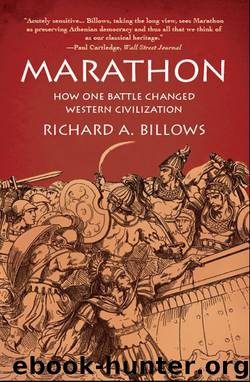
Author:Richard A.Billows [BILLOWS, RICHARD A.]
Language: eng
Format: epub
Tags: HIS000000, HIS002000, HIS002010, HIS027000
ISBN: 9781468303063
Publisher: The Overlook Press
Published: 2012-04-21T00:00:00+00:00
CHAPTER 4
THE GROWTH OF CONFLICT BETWEEN PERSIANS AND GREEKS
RELATIONS BETWEEN THE PERSIAN EMPIRE AND THE GREEKS started out as they were to continue; on the whole, badly. When Cyrus came to be at war with the Lydian Empire of Croesus in 546, he discovered—how we don’t know—that Croesus’s empire included, on its western seaboard, a number of important city-states whose inhabitants, not Lydians but Greeks, had only relatively recently been subdued by the Lydians. He calculated that these city-states might feel hostility towards their Lydian overlord, and that he might turn such hostility to his advantage. As we’ve seen, he sent messengers to the Greek cities of western Anatolia inviting them to secede from Lydian domination and become his friends. As it turned out, Greek sentiments towards Croesus were by no means hostile—in fact Croesus was a fairly mild ruler and the Greeks were inclined to admire him—and in any case the Ionian Greeks were impressed by Croesus’s power and wealth and expected him to win. Thus they turned down Cyrus’s invitation— until it was too late. Only when it was clear that Croesus had lost did the Greek cities send representatives to Cyrus reminding him of his offer of friendship and saying that they would now like to take him up on it. Cyrus, according to Herodotos, responded with a charming fable: a pipe-player once saw some fish in the sea and played his pipes to them in the hopes that they would come to the shore. The fish ignored his playing, so he took a net, cast it into the sea, and caught them. When he had hauled the net on land and saw the fish flopping about he said: “you need not dance for me now, since you were unwilling to dance for me when I played my pipes.” In other words, Cyrus let the Ionian Greeks know that they had missed their opportunity, and they would now dance to his tune whether they liked it or not.
PERSIA AND THE GREEKS
The Greeks returned to their cities, closed their gates, and manned their walls hoping to see off the Persian threat. But Cyrus’s general Harpagos captured the cities of Ionia one by one through the use of siege ramps, and so the Greek cities of the Anatolian coast came under Persian rule. On the whole, the Persians did not treat these eastern Greek cities badly. Each city was placed under the rule of a trusted local leader—from the Greek perspective, a tyrant—who reported to the Persian satrap at Sardis. And of course the Greeks had to pay tribute to the Persian king, but Persian tribute payments were not excessively burdensome. In fact, the Ionian cities enjoyed several decades of relative peace and prosperity under Persian rule during the second half of the sixth century. Of course, many eastern Greeks lamented the loss of their freedom. Some, rather than accept Persian rule, had chosen exile from their homeland, as individuals or en masse.
Most of the people of Phokaia, for
Download
This site does not store any files on its server. We only index and link to content provided by other sites. Please contact the content providers to delete copyright contents if any and email us, we'll remove relevant links or contents immediately.
| Africa | Americas |
| Arctic & Antarctica | Asia |
| Australia & Oceania | Europe |
| Middle East | Russia |
| United States | World |
| Ancient Civilizations | Military |
| Historical Study & Educational Resources |
Room 212 by Kate Stewart(5119)
The Crown by Robert Lacey(4814)
Endurance: Shackleton's Incredible Voyage by Alfred Lansing(4780)
The Iron Duke by The Iron Duke(4354)
The Rape of Nanking by Iris Chang(4211)
Joan of Arc by Mary Gordon(4109)
Killing England by Bill O'Reilly(4001)
Say Nothing by Patrick Radden Keefe(3983)
I'll Give You the Sun by Jandy Nelson(3445)
Shadow of Night by Deborah Harkness(3366)
Hitler's Monsters by Eric Kurlander(3341)
Mary, Queen of Scots, and the Murder of Lord Darnley by Alison Weir(3210)
Blood and Sand by Alex Von Tunzelmann(3203)
Eleanor & Park by Rainbow Rowell(3169)
Darkest Hour by Anthony McCarten(3129)
Margaret Thatcher: The Autobiography by Thatcher Margaret(3081)
Book of Life by Deborah Harkness(2937)
Red Famine: Stalin's War on Ukraine by Anne Applebaum(2932)
The One Memory of Flora Banks by Emily Barr(2863)
